
User's guide
The Mining Impacts Calculator is a tool that uses an economic formula that calculates the estimated effects on the environment and society by inputting variables such as the size of the mine, the amount of gold produced and the time of extraction. The automated formula uses average mining productivity and data-driven impact parameters systematized by the academic literature and by interviews with researchers and miners, to deliver contextualized data to the user.
Set location
To begin, you can include information on the context of your research so that the calculator can more accurately estimate the value of the environmental and social impacts. Based on the location for your search, you may add details such as the:
Density and size of the nearby population;
Average fish consumption;
Cost of transportation to the affected area
If you don't have specific information, you can still operate the calculator. If this is the case, the average values for context and impact will be automatically included. The results and their explanations will then be generated.
Types of mining
Alluvial
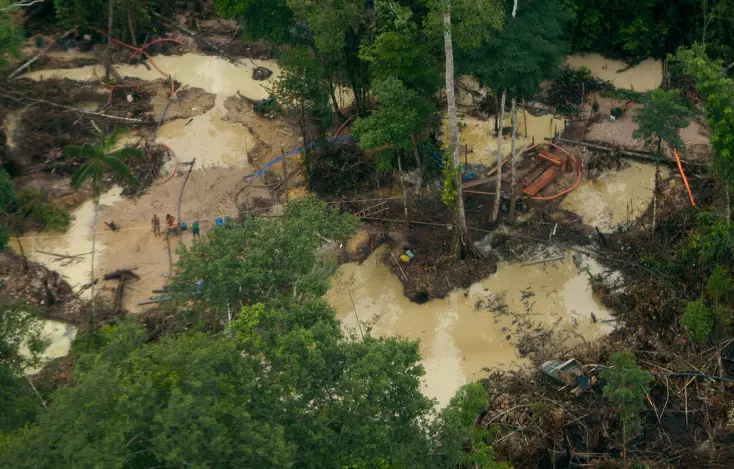
Extraction of ore by digging open trenches (cavities), generally on the banks of rivers. Also known as garimpo de barranco, it is the most common type of illegal mining in the Amazon. For this type of extraction, analysis can be conducted using two input units: impacted hectare or grams of extracted gold.
Ferry
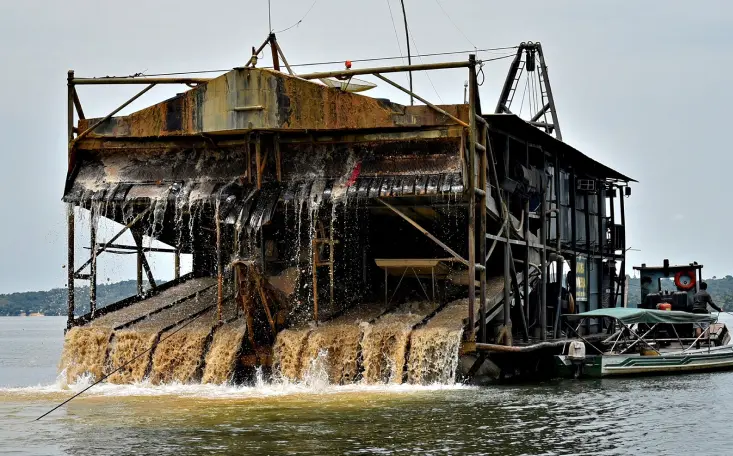
Extraction of ore by dredging riverbeds. The ore is then carried out on rafts or floating boats. This does not generate deforestation, but it has a greater impact in terms of mercury contamination of rivers. For this type of extraction, analysis can be conducted using two input units: the number of dredges in a year or grams of extracted gold.
Pit
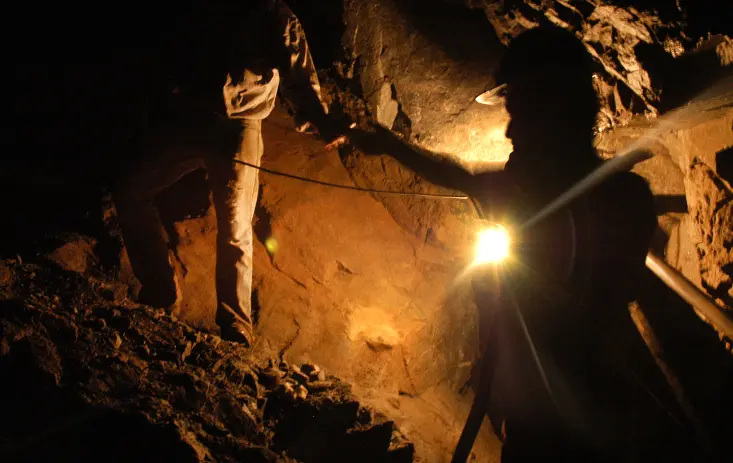
Extraction of ore through underground tunnels. It has lower impacts in terms of deforestation and erosion, but it also uses mercury in mineral processing. For this type of extraction, analysis can be conducted using two input units: years of mining exploitation or grams of extracted gold.
If the type is not specified, the impacts of the most common type of mining in the Amazon will be considered: alluvial mining.
Retort use
The retort is a device that reduces the dispersion of mercury by evaporation during amalgamation.
Units of measurement
Amount of gold
Considers the average context of productivity and impact of mining in the Amazon. It is used when illegal gold is seized without knowing its exact origin. Applied in all types of mining: alluvium, ferry or well.
Mine size
For alluvial mining, the size of the mine is obtained by multiplying its area by the average depth of the pits. It is used when the location of illegal mining is known, with the possibility of detailing the context with specific parameters. Applied only in alluvial mining.
Number of rafts in a year
For ferry mining, it is necessary to know the number of bolts/dredgers in a given river. When using the tool, it is also possible to insert the power of the ferry's engine, which in Brazil and Ecuador is on average 55hp, in Colombia, 100hp, and in Peru, 130hp. Only applied to ferry mining.
Years of exploration of the mine
The age of the mine can be used as an approximation of the size, amount of gold extracted and mercury used. Applied only in well mining.
Number of backhoes
This unit was added exclusively for Peru, at the request of the Attorney General's Office, which takes into account both the number of machines and their performance (m³/h).
Value hypothesis
The calculator weights the values across literature. The impacts can then be calculated based on average values (conservative scenario) or maximum values (precautionary principle scenario).
Inflation
The original values of the calculator are: 2022 for Brazil; 2023 for Colombia, Peru and Ecuador; 2024 for Guyana, Suriname and Bolivia. To update them for the current year, enter the accumulated inflation value. For example, if between 2023 and 2025 there was accumulated inflation of 7.5%, enter the value 7.5 in the indicated field. Annual inflation values by country can be seen in the World Bank database.
Uses of the Calculator
The Mining Impacts Calculator can be used for three main purposes:
1. To estimate values of environmental damage to support the definition of compensation and compensation;
2. To estimate efficient investment levels for impact planning and prevention;
3. To estimate efficient levels of investment in mercury-free technologies.